“Occupational therapy could be hiding in a game of table tennis.”
If someone had said that to me a few weeks ago, I probably would have smiled politely.
Now, I completely understand what they mean.
When an email landed in my inbox inviting me to attend a Student Learning Day with Sport for Confidence at Basildon Sporting Village, I thought I was going to learn about adaptive sport and community rehabilitation. As a third-year occupational therapy student, I expected conversations about assessments, interventions and outcome measures.
I got all of those.
But I left with something much bigger.
I left seeing occupational therapy in places I hadn’t noticed before.
Walking into the sports hall, I was met with table tennis tables, boccia courts and people chatting over coffee. At first glance, it looked like any community sports session.
Then I started looking through an occupational therapy lens.
A chair positioned beside a participant wasn’t simply a chair. It was an intervention that enabled balance and participation.
An adapted table tennis bat wasn’t just equipment. It was the difference between watching and playing.
Removing the net wasn’t lowering expectations. It was creating the conditions for success.
Every adaptation seemed to communicate the same quiet message:
You belong here.
One of the biggest lessons I took away was that sport was never really the intervention.
Belonging was.
As occupational therapists, we don’t ask people to fit the activity. We adapt the activity to fit the person.
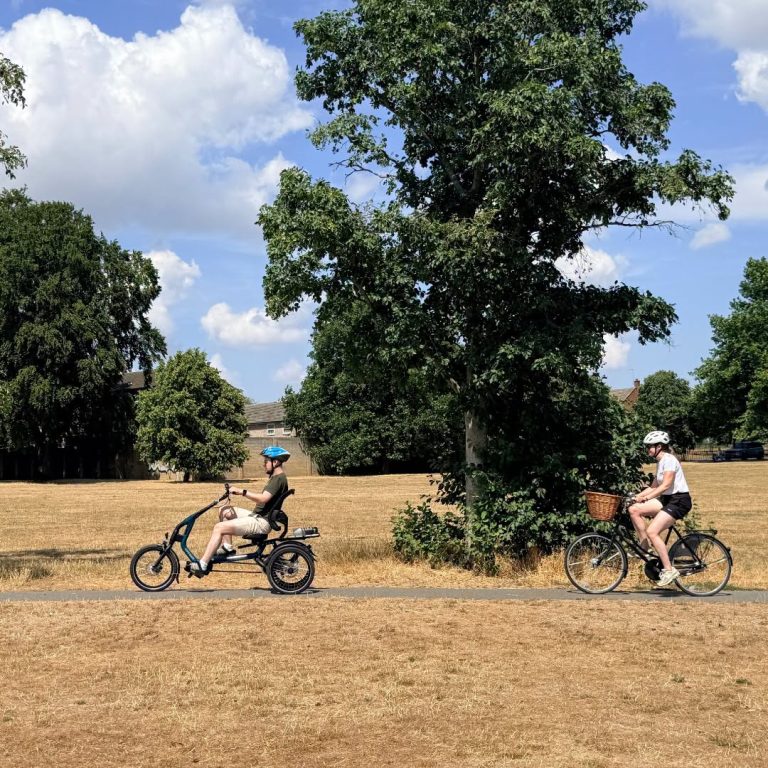
Throughout the morning I watched activities being carefully graded to meet people exactly where they were. Sometimes the ball was rolled across the table instead of being hit. Sometimes participants bounced and caught it before progressing to a rally. Some people played standing, others played seated, while adaptive equipment supported different levels of movement and function.
It wasn’t about making the activity easier.
It was about making participation possible.
What surprised me most was that grading didn’t always involve the activity itself.
Sometimes the intervention was simply walking into the leisure centre.
Sometimes it was sitting in the café and talking.
Sometimes it was looking inside the gym before deciding to leave.
That, too, was occupational therapy.
Confidence doesn’t suddenly appear when someone picks up a bat or throws a ball. More often, it begins the moment someone feels safe enough to take the next small step.
As the sessions unfolded, I realised I wasn’t just watching people play sport.
I found myself constantly observing.
Grip.
Balance.
Standing tolerance.
Problem solving.
Communication.
Confidence.
Social interaction.
Occupational therapists are taught to notice the things that often go unseen, and I realised that every rally, every throw and every conversation was also an assessment. The activity remained enjoyable, but the clinical reasoning never stopped.
One discussion in particular stayed with me.
We began talking about health inequalities, accessibility and community engagement. As one of the few Black women in the room, I found myself asking a question that felt impossible to ignore.
Who isn’t here?
Occupational therapy teaches us to notice participation, but it also asks us to notice absence.
Who doesn’t feel these spaces are for them?
Whose barriers remain invisible?
Who never makes it through the door?
I was encouraged to hear how Sport for Confidence actively thinks about these questions, from offering women-only sessions to working alongside Muslim communities and recognising how culture, faith and lived experience influence participation. We also discussed the importance of educating everyone within the leisure centre, not just therapists, but reception staff, volunteers and the wider team because inclusion begins long before an activity starts.
It begins with feeling welcomed.
That conversation reminded me that occupational justice isn’t only about adapting an activity.
It’s about creating environments where people genuinely feel they belong.
Another insight challenged my own understanding of occupational therapy.
Before attending the day, I largely associated community rehabilitation with recovery following illness or injury.
Now I see something much broader.
Supporting someone to build the confidence to enter a leisure centre independently.
Reducing isolation.
Preventing falls.
Creating meaningful routines.
Developing friendships.
Helping someone discover an occupation that becomes part of who they are.
This is occupational therapy too.
As I travelled home, one thought stayed with me.
We’re all entitled to move.
I don’t simply mean physically.
We’re entitled to move into communities that welcome us.
Into occupations that give us purpose.
Into spaces where our diagnosis isn’t the first thing people notice.
Into environments where culture is understood, difference is respected and participation is expected rather than exceptional.
Watching someone take their first tentative steps into a leisure centre reminded me that occupational therapy isn’t really about sport.
It’s about possibility.
It’s about recognising potential before someone can see it for themselves.
It’s about creating opportunities for people to reconnect with confidence, identity and belonging through meaningful occupation.
I thought I was going to learn about sport.
I did.
I learnt that sport can rebuild confidence.
I learnt that sport can restore identity.
I learnt that sport can create belonging.
But most importantly, I learnt that occupational therapy has an extraordinary way of hiding in plain sight.
Sometimes, it looks like a game of table tennis.
Sometimes, it looks like a game of boccia.
And sometimes, it begins with a simple belief that every person deserves the opportunity to participate.
Because we’re all entitled to move.
Makeda Bernard
Occupational Therapy Student, University of East London
Founder, OT Yourself CIC